Thai speech dataset
About this dataset
1. Product Overview
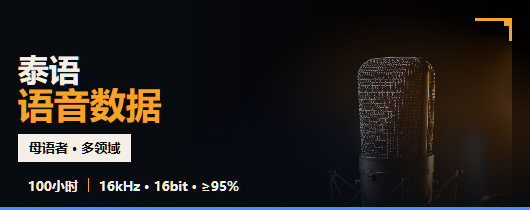
A Thai speech database totaling 100 hours, with a sampling rate of 16,000 Hz and a bit depth of 16 bits. The speakers are native Thai speakers aged between 7 and 70 years old. Transcriptions have been meticulously reviewed and annotated by professional linguists, followed by rigorous quality assurance, achieving a text accuracy rate exceeding 95%.
2. Text Design
Text Domains
To accommodate real-world applications, the text covers a broad range of domains, including:
- General Scenarios: everyday conversations, family interactions, news broadcasts, voice-controlled commands, human-computer interaction.
- Commercial Scenarios: e-commerce, catering, finance, logistics, meetings.
- Industrial Scenarios: agriculture, electronics manufacturing, automotive, textiles.
- Public Service Scenarios: government inquiries, hospital consultations, school teaching.
- Complex Noise Scenarios: street scenes, buses, subways, conference rooms, indoor home environments.
Considering the wide age range of speakers and their diverse application contexts, text domains are differentiated for each speaker group as follows:
- Children: Primarily focused on command-based interactions, supplemented by simple conversational texts, covering home, in-car, human-computer interaction, and general daily dialogue.
- Young and Middle-Aged Adults: This group has the highest usage frequency and the broadest coverage, encompassing home, in-car, human-computer interaction commands, dining, finance, logistics, medical consultations, industrial manufacturing, education, and casual daily chats.
- Seniors: Their domain lies between children and young/middle-aged adults, covering home, in-car, human-computer interaction commands, dining, news, medical consultations/healthcare, entertainment, travel, and everyday casual conversation. For simple command phrases, fast, medium, and slow speech rates are distinguished.
The specific number of sentences assigned to each category is as follows:
Domain · Children · Youth & Middle-Aged · Seniors
Home Commands · 25*3 · 5*3 · 20*3
In-Car Commands · 25*3 · 5*3 ·
Human-Computer Interaction Commands · 25*3 · 5*3 · 20*3
Family Conversations · 50 · ·
Dining · · 100 · 55
Finance · · 90 ·
Logistics · · 100 ·
Medical Consultations/Healthcare · · 100 · 55
News · · · 55
Entertainment · · · 55
Travel · · · 55
E-Commerce · · 100 ·
Industrial Manufacturing · · 80 ·
Education and Teaching · · 80 ·
General Daily Texts · 50 · 105 · 55
Summary · 325 · 800 · 450
In addition to reading aloud, children’s recordings also include guided dialogues. The thematic coverage per individual is as follows:
Domain · Example · Hours
Family Conversation (Parent-Child) · Parent: “What’s your favorite game? Do you enjoy playing it?” Child: “I love building blocks—when I finish constructing a castle, I feel so accomplished!” · 0.1
Dialogue · ·
Educational Exchange (Teacher-Student) · Teacher: “How did you approach this math problem? Is there anything you don’t understand?” Child: “I can do addition, but I always mix up subtraction. Could you explain it again, please?” · 0.1
Casual Chat (Classmates, Friends, etc.) · A: “That game today was really fun—let’s play together tomorrow!” B: “I might not be able to make it tomorrow, how about the day after?” · 0.05
Transcription Guidelines
Transcribers draft text based on the audio they hear, striving to ensure complete consistency between written content and spoken words. General guidelines include:
- Transcribed content must exactly match the spoken audio—no extra words, missing words, or errors.
- Thai script and punctuation should be preceded by a space.
- Single letters should follow the format: Thai letter + half-width space + letter, with an additional space afterward—for example, “รุ่น A ของโทรศัพท์ขายดีมาก.”
- Proper English abbreviations should retain their original spelling—e.g., USB, Wi‑Fi.
- Consecutive letters should be separated by spaces—for example, “A B C.”
- Only classroom pronunciation symbols require annotation; enclose them within / /, leaving one space between the Thai text and the left slash—for example, “เสียง /k/ในภาษาไทยออกเสียงง่าย.”
3. Directory Structure and Naming Conventions
Directory Structure
The data directory tree is organized as follows:
└─DOC (Documentation Files)
││├─content.txt (List of Transcribed Content)
││├─spk-info.txt (Speaker Information Table)
└─SPEECHDATA (Audio Folder)
││├─T0001 (Speaker ID Number)
││ │├─T0001W0001.wav (Audio File)
Naming Conventions
CORPUS/USAGE/SPEAKER_ID/SPEECH_IDe.g./SPEECHDATA/T0001/T0001W0001.wav
Directory Name · Content · Notes
CORPUS · · Speech Database Identifier
USAGE · SPEECHDATA · Audio Folder
SPEAKER_ID · T0001 · Folder for Speaker ID Numbers
SPEECH_ID · T0001W0001.wav · Audio File
4. Speaker Information
Gender Information
The database contains a total of 123 speakers, comprising 60 males and 63 females, as shown below:
Gender · Male · Female · Total
Proportion · 48.8% · 51.2% · 100%
Age Information
The speakers’ ages span from 7 to 70 years old, distributed as follows:
Age Group · Number of Speakers · Percentage (%)
7–18 Years Old · 10 · 8.1%
18–35 Years Old · 105 · 85.4%
36–60 Years Old · 6 · 4.9%
61–70 Years Old · 2 · 1.6%
Total · 123 · 100%
5. Recording Plan
Recording Environment
Speakers record indoors in quiet settings such as homes or other tranquil spaces, free from significant background noise.
Recording Method
Speakers use self-developed recording tools and record at close range. Recording formats include reading aloud, natural speech, and guided dialogue:
- Reading Aloud: Reading pre-assigned texts.
- Natural Speech: Given a scenario and text, speakers produce sentences naturally without strict adherence to the provided text.
- Guided Dialogue: Structured, facilitated conversations.
Data Sample Download
Samples
- Audio sample 1
- Audio sample 2
- Audio sample 3
- Audio sample 4