Mandarin Chinese Spoken Audio Database
About this dataset
1. Product Overview
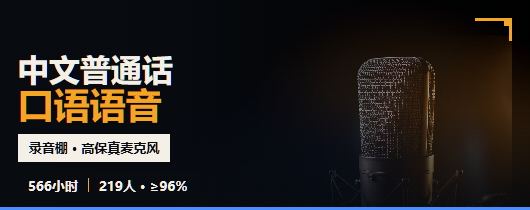
The Mandarin Chinese spoken language corpus comprises 566 hours of audio, with 188.7 hours recorded in a single channel. The recordings are in Chinese and were made by 219 speakers from northern China. Recording took place in a professional studio, where speakers used high-fidelity microphones to deliver spontaneous speech. This corpus has been transcribed and annotated by expert linguists and subjected to rigorous quality assurance, achieving a text accuracy rate exceeding 96%. It can be utilized for research in voice biometrics, speech recognition, and related fields.
2. Speaker Information
Gender Distribution
The corpus includes a total of 219 speakers: 115 males and 104 females.
Gender · Male · Female · Total
Proportion · 52.3% · 47.7% · 100%
Age Distribution
The speakers’ ages range from 16 to 58 years, distributed as follows: Group A (16–25 years), Group B (26–40 years), and Group C (41 years and older).
Age Group · Number of Speakers · Percentage (%)
16–25 · 127 · 58.3%
26–40 · 56 · 25.2%
41+ · 36 · 16.5%
Total · 219 · 100%
3. Data Recording Environment
Recording Environment
The recording was conducted in a soundproof studio with no other voices present.
Recording Equipment
A high-fidelity microphone was used.
Recording Method
Speakers recorded in the studio using a high-fidelity microphone, capturing audio at three distances: 0 cm (P03), 1 meter (P04), and 2 meters (P05). There were no restrictions on content; speakers spoke freely, with each recording lasting less than 10 minutes but not exceeding one hour.
4. Speech Transcription
Transcribers rendered the audio into written text, striving to ensure complete consistency between the transcription and the original speech. General guidelines include: 1) Transcriptions must exactly match the spoken content—no extra words, omissions, or errors. 2) Numbers should be written in Chinese characters, such as “一二三” rather than “123.” Distinguish between “一” and “幺,” and between “二” and “两.” 3) English pronunciations should be transcribed into corresponding Chinese characters or left in English, depending on context. Specific rules apply: All letters or words in URLs must be capitalized—for example, “www.abc.com” becomes “三W点A B C点com.” English words within the speech should be transcribed in lowercase, while English letters should be capitalized. Certain proper nouns or acronyms requiring all capitalization should retain their original formatting, e.g., “C E O,” “C C T V.” 4) Annotations must fully reflect the actual pronunciation without omission. 5) If individual words in a sentence are unclear, mark them with an asterisk (*); if several words are unclear, use a single asterisk for the entire sentence. Sentences where more than 50% of the content is unintelligible should be discarded. 6) Unusual noises—such as laughter, coughs, or other vocal sounds—should be marked with symbols at the point of occurrence, as follows:
Noise Type · Symbol · Description
1 · <$> · Laughter
2 · <%> · Coughing
3 · <#> · Yawning, etc.
4 · <@> · Mobile phone ringtone
5 · <-> · Sound of chair movement
6 · <_> · Sound of table movement
7 · <*> · Unintelligible speech
8 · <fy> · Occasional dialectal words
5. Data File Directory
The data directory structure is organized as follows:
└─DOC (Text Documentation Folder)
││├─content.txt (Audio List)
││├─spkrinfo.xlsx (Speaker Information)
│
└─SPEECHDATA (Data Folder)
│├─0001 (Speaker ID)
│├─P03 (Recording Position)
│├─00001.wav (Audio File)
│├─P04 (Recording Position)
Sample Data Download
Samples
- Audio sample 1