Chinese–English Wake Word Speech Database
About this dataset
1. Overview
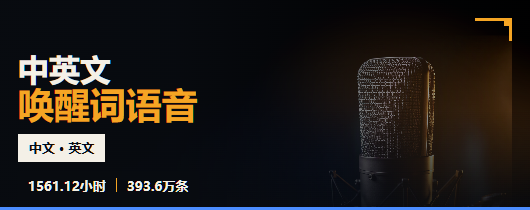
The database contains 1,561.12 hours of speech data, including 3,936,003 wake-up-word speech files. Database languages: Chinese and English ◎ Recording area: China ◎ Wake-up words for recording: “Hi mia” and the Chinese phrase “你好,米雅” ◎ Speakers: 254 participants ◎ Environment: Real home environment ◎ Device setup: Seven different positions are set for recording, including: ◎ 1) Six 16-channel circular microphone arrays (16 kHz, 16-bit) for far-field recording; 2) One Hi-Fi microphone for close-talk recording (44.1 kHz, 16-bit). The database was transcribed by professional speech annotators following a rigorous QA process, achieving 100% word accuracy, making it suitable for research in voiceprint recognition, wake-up word recognition, and related fields.
2. Database Structure
File Structure
File FolderFolder
│ .pdf(Database specification)
│ spk_info.xlsx(Speaker information)
└─SPEECHDATA(Data folder)
│├─speech(Wake-up words speech)
File Path Rules
\SPEECHDATA\speech\wav\\\.wave.g. \SPEECHDATA\speech\wav\145\145_1_recorded0_001_normal.wav
Field · Value · Field Meaning
· 145–398 · Speaker ID
.wav · _<pointID>_<micID>_<textID>_<speed>.wav · Audio file ID
\SPEECHDATA\speech\text\.txte.g. \SPEECHDATA\speech\text\145.txt
Field · Value · Field Meaning
· 145–398 · Speaker ID
_<pointID>_<micID>_<textID>_<speed>.wav.g. 145_1_recorded2_001_normal.wav
Field · Value · Field Meaning
· 1–6: Circular microphone array IDs; 7: Hi-Fi Mic ID · Point position ID
· recorded2–recorded17 · Microphone ID within an array
· 001–160 · Text ID
· Slow, normal, fast · Speaking speed
3. Text Script Design
The database contains two types of wake-up words:
Wake-up Word 1 · 你好,米雅(Chinese of “ni hao, mi ya”)
Wake-up Word 2 · hi, mia
The distribution of text scripts in the database is as follows: Text IDs 001–120 are recorded in noisy environments; Text IDs 121–160 are recorded in clear environments. Noise information for each speaker is included in the speaker information file (spk_info):
Text ID · Environment · Wake-up word and speaking speed
001–020 · Wake-up Word 1 at normal speed ·
021–040 · Wake-up Word 2 at normal speed ·
041–060 · Wake-up Word 1 at fast speed ·
Noisy environment · ·
061–080 · Wake-up Word 2 at fast speed ·
081–100 · Wake-up Word 1 at slow speed ·
101–120 · Wake-up Word 2 at slow speed ·
121–140 · Wake-up Word 1 at normal speed ·
Clear environment · ·
141–160 · Wake-up Word 2 at normal speed ·
4. Recording Design
Recording Environment
1. The recording environment is a real home setting, including electrical appliances, tables, chairs, and more. 2. Each speaker remains in a fixed position during recording.
Devices
The recording equipment includes a Hi-Fi microphone and a PDM microphone array.
Recording Method
The recordings of each speaker can be categorized into three subsets based on speaking speed (normal, fast, or slow). We simulated realistic smart-home scenarios by introducing noise sources such as TVs, music, and background sounds into the room. Room settings are shown in Figure 1. The high-fidelity microphone is positioned 25 cm away from the speaker. Circular microphone arrays are arranged around the person at distances of 1 m, 3 m, and 5 m. Noise sources are randomly placed near one of the microphone arrays for each speaker. Room settings and positional information are detailed below:
Mic Position ID · Distance (m) · Height (m) · Device
1 · 1.5 · 1 · Microphone array
2 · 1 · 1 · Microphone array
3 · 3 · 1 · Microphone array
4 · 3 · 1 · Microphone array
5 · 3 · 1 · Microphone array
6 · 5 · 1 · Microphone array
7 · 0.25 · 1 · Hi-Fi Microphone
5. Transcription Specifications
1. The transcription text must match the audio content exactly—no redundant, missing, or incorrect text is permitted. 2. If English words appear in the text, they should be transcribed according to pronunciation, e.g., “hi, mia.” 3. The completeness of transcription must align with the actual pronunciation in the audio.
6. Speaker Information
The information for each speaker, recorded in the spk_info file, includes mission ID, gender, age, noise type, as shown in the example below:
Mission ID · Gender · Age · Noise Type · Noise Position
145 · Men · 25 · Cartoon · Position 2
Mission ID: Each speaker has only one mission ID, and each mission comes with a unique script package for recording. A speaker can complete only one mission. Gender: Male/Female Age: The speaker’s age at the time of recording Noise Type: Singing, pure music, TV shows, cartoons, fan noise, sports rebroadcasts, variety shows Noise Position: Randomly placed near one of the microphone arrays for each speaker. There are 254 speakers in this database, all originating from northern China (with a northern Chinese accent).
7. Copyright
All copyright rights to this document are reserved by Beijing Shell Shell Technology Co., Ltd., which holds full authority over amendments, updates, and final interpretations of this document.
Sample Data Download
Samples
- Audio sample 1