Chinese Multi-Person Synthesis Database
About this dataset
1. Product Overview
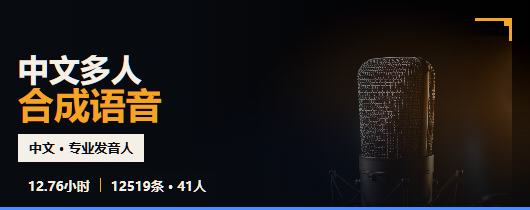
The Chinese multi-person speech synthesis database contains a total of 12.76 hours of audio, comprising 12,519 utterances. The recording language is Chinese, and the recordings were made in China. Forty-one professional speakers participated in the recording process, which took place in a professional recording studio. The recording equipment was high-fidelity, with an audio sampling rate of 48 kHz and a bit depth of 16 bits. This database has been transcribed and annotated by professional linguists, with annotations including characters, pinyin, and prosodic information, and has undergone rigorous quality assurance, achieving a text accuracy rate of 99%.
2. Recording Corpus
The corpus consists of approximately 300 sentences per recording file, processed as follows: ⚫ De-identification: Politically sensitive, personally identifiable, or sexually explicit/violent content has been removed. ⚫ Comprehensive phoneme coverage. ⚫ Removal of symbols such as <, >, [, ], ~, /, \, =. ⚫ Exclusion of content containing languages other than Chinese and English. ⚫ Omission of single sentences exceeding 30 characters. ⚫ Standardized formatting.
3. Speaker Information
Basic Information Records
Speaker information includes task ID, gender, and age range.
Task ID · Gender · Age Range
W0001 · Male · A
Task ID: Each speaker is assigned one unique task ID, corresponding to one recording file. Each speaker may only participate once. Age ranges: A (18–25 years), B (26–36 years).
Speaker Demographic Characteristics
Gender Ratio
The database comprises 41 speakers in total—14 males and 27 females.
Gender · Male · Female · Total
Proportion · 34% · 66% · 100%
Age Distribution
Age groups: A (18–25 years); B (26–40 years).
· Age Group · Number of Speakers · Proportion
A · 18–25 years · 17 · 41.5%
B · 26–36 years · 24 · 58.5%
Total · 100 · 100% ·
4. Data Recording Environment
Recording Environment
Recordings were conducted in a professional recording studio, where background noise was kept below 35 dBSPL and reverberation time remained under 150 ms.
Recording Equipment
The recording equipment was high-fidelity.
Recording Method
Speakers maintained a distance of 20–30 cm from the microphone, reading the provided text aloud at a normal volume and pace. Audio amplitude was kept between -3 dBFS and -9 dBFS, avoiding clipping or harsh sibilance.
5. Speech Data Transcription
Transcribers rendered the spoken content into written form, striving for complete alignment between the text and the original audio pronunciation. General guidelines include: 1) Transcriptions must exactly match the spoken content, with no extra words, omissions, or errors. 2) Numerals should be written out in Chinese characters—for example, “一二三” rather than “123.” Distinguish between “一” and “幺,” and between “二” and “两.” 3) Annotation completeness must reflect actual pronunciation; no deletions are permitted. 4) Pinyin and tones should be transcribed according to the spoken pronunciation, ensuring consistency between pinyin and text, while accounting for tone sandhi and erhua. For instance, clarify whether “这” is pronounced “zhe4” or “zhei4.” Understand tone changes: e.g., the third tone becomes second when followed by another third tone; the fourth tone shifts to second before a third tone. For multiple third tones, determine semantic pauses based on proximity and apply tone sandhi accordingly. 5) Erhua: Add “r” to the original syllable—for example, “花儿” becomes “huar.” 6) Prosodic annotation covers prosodic words (#1), prosodic phrases (#2), intonational phrases (#3), and intonational group boundaries (#4). In cases where audio and grammar differ, prioritize the actual audio pronunciation; if adjacent levels are ambiguous, adopt the lower-level annotation.
6. Data File Directory
Directory Structure
The data directory tree is structured as follows:
└─DOC (textual documentation)
││├─all_wav_list.txt (audio list)
││├─spkrinfo.xlsx (speaker information)
││├─content.txt (speaker information)
│
└─SPEECHDATA (data folder)
│├─P0001 (speaker information)
││ ││ P0001W0001.wav (audio file)
Naming Rules
Directory Naming Convention
<USAGE>/<Gender>/<SpeakerID>/<mood>/<wav_ID>e.g. SPEECHDATA/P0001/P0001W0001.wav
Directory · Content · Notes
USAGE · SPEECHDATA · Folder name
SpeakerID · P0001 · Speaker ID
wav_ID · P0001W0001.wav · Audio file
File Naming Convention
<SPEAKER_ID><WAV_NUM>e.g. P0001W0001.wav
File · Content · Notes
SPEAKER_ID · P0001 · Speaker ID
WAV_NUM · W0001.wav · WAV number
Data Sample Download
Samples
- Audio sample 1
- Audio sample 2
- Audio sample 3