Shaanxi Dialect Speech Database
About this dataset
1. Product Overview
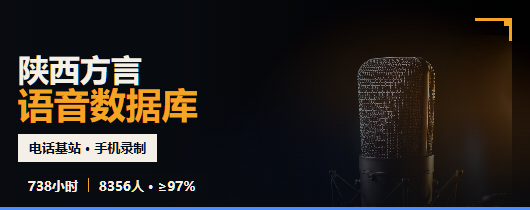
The Shaanxi dialect speech database contains a total of 738 hours of recordings. The recorded language is the Shaanxi dialect, and the recordings were made in China. A total of 8,356 speakers were recruited, who used their mobile phones to make calls to base stations under quiet conditions. The data has undergone professional calibration, achieving a text accuracy rate of over 97%. This database can be used for research in areas such as voiceprint recognition and speech recognition.
2. Speaker Information
Gender Ratio
The database includes a total of 8,356 speakers: 4,086 males and 4,270 females.
Gender · Male · Female · Total
Ratio · 48.9% · 51.1% · 100%
Age Distribution
The speakers’ ages range from 20 to 66 years old, with the following breakdown: A (20–30 years), B (31–40 years), C (41–50 years), D (51–60 years).
· Age Group · Number of Speakers · Percentage
A · 20–30 years · 1,763 · 21.10%
B · 31–40 years · 3,304 · 39.54%
C · 41–50 years · 2,474 · 29.61%
D · 51–60 years · 815 · 9.75%
Total · 8,356 · 100% ·
Regional Distribution
The speakers are all from Shaanxi Province, with the following regional distribution: Guanzhong, Northern Shaanxi, and Southern Shaanxi:
Region · Number of Speakers · Percentage
Guanzhong · 4,996 · 59.8%
Southern Shaanxi · 1,639 · 19.6%
Northern Shaanxi · 1,721 · 20.6%
Total · 8,356 · 100%
3. Data Recording Environment
Recording Environment
A quiet indoor setting, free from echoes and other voices.
Recording Equipment
Commonly available smartphones, including Apple, Huawei, Xiaomi, OPPO, and others. The data is stored in 8 kHz, 16-bit WAV format.
Recording Method
Speakers hold their phones in a quiet room and make calls to base stations, reading aloud at a normal speaking pace.
4. Speech Data Transcription
Transcribers convert audio into written text, striving to ensure that the transcription accurately reflects the spoken content. General guidelines include: 1) The transcription must exactly match the spoken words—no extra or missing words, no errors. 2) Numbers should be transcribed using Chinese characters—for example, “one two three” instead of “123.” Pay attention to distinguishing between “one” and “yao,” and between “two” and “liang.” 3) English pronunciation in the audio should be rendered in corresponding Chinese characters or English. Specific cases include: All letters or words in URLs should be capitalized—for example, “www.abc.com” becomes “three W dot A B C dot com.” English words within the audio should be transcribed entirely in lowercase. Individual English letters should be transcribed entirely in uppercase. For certain proper nouns written in all caps, maintain capitalization without spaces—for example, CEO, NBA, etc. 4) The completeness of annotations must align with actual pronunciation; no omissions allowed.
5. Data File Directory
Directory Structure
The directory tree structure is as follows:
└─DOC (Text Description Files)
││├─content.txt (Transcribed Text)
││├─wav_list.txt (Audio List)
││├─spkrinfo.xlsx (Speaker Information)
│
└─SPEECHDATA (Data Folder)
│├─S0457 (Speaker ID)
││ ││ S0457_0001.wav (Audio File)
Naming Rules
Directory Naming Convention
<USAGE>/<SpeakerID>/<wav_ID> e.g., SPEECHDATA/S0457/S0457_0001.wav
Directory · Content · Notes
USAGE · SPEECHDATA · Folder Name
SpeakerID · S0457 · Speaker ID
wav_ID · S0457_0001.wav · Audio File
File · Content · Notes
SpeakerID · S0457 · Speaker ID
SpeakerID_<wav_ID> · 0001.wav · Audio ID
File Naming Convention
<SpeakerID>_<wav_ID> e.g., S0457_0001.wav
Sample Data Download
Samples
- Audio sample 1
- Audio sample 2
- Audio sample 3
- Audio sample 4