Speech Data for Young Children – Chinese
About this dataset
1. Product Overview
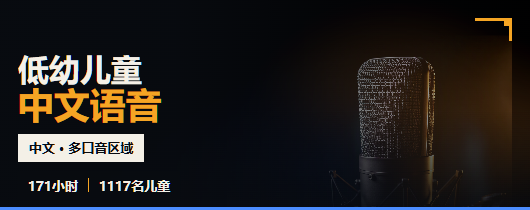
The children’s speech database comprises a total of 171 hours. The recording language is Chinese, and the recordings were made in China. A total of 1,117 speakers from various regional accents across China participated in the recording process. Recordings were conducted in a quiet indoor environment using mobile phones at a sampling rate of 16 kHz and 16 bits. This database has been transcribed and annotated by professional speech annotators and subjected to rigorous quality assurance, achieving a text accuracy rate exceeding 95%.
2. Product Catalog Structure
Catalog Structure
Data catalog structure data catalog structure
└─DOC (textual documentation)
││├─wav_list.txt (audio file list)
││├─content.txt (speech text content)
││├─spk_info.xlsx (speaker information)
└─SPEECHDATA (data folder)
│├─A0001 (speaker folder)
││ ││ A0001CO0001.wav (audio file)
Naming Conventions
CORPUS/USAGE/SPEAKER_NUM/POINT_ID/SPEECH_IDe.g./SPEECHDATA/A0001/A0001CO0001.wav
Directory Name · Content · Notes
CORPUS · · Speech database ID
USAGE · SPEECHDATA · Folder name
SPEAKER_NUM · A0001 · Speaker folder name
SPEECH_ID A0001CO0001.wav WAV file
3. Text Design
Corpus Construction
Considering applications of speech recognition in smart homes, education, industrial production, and other fields, the corpus design includes poetry, fairy tales, food names, numerical strings, and more. The corpus pool is processed according to established rules: ⚫ De-identification: Politically sensitive, personally private, or sexually violent content is removed. ⚫ Removal of symbols such as <, >, [, ], ~, /, \, =. ⚫ Exclusion of materials containing languages other than Chinese and English. ⚫ Elimination of single sentences exceeding 25 characters. ⚫ Standardization of format.
Text Structure
To ensure broad speech coverage and phoneme balance, the recorded texts are divided into two categories: Level A (ages 3–6) and Level B (ages 7–10). Each Level A set contains 200 sentences, while each Level B set contains 275 sentences, drawn from the corpus pool with the following structure:
Category · Content Number · Level A · Level B
Control Words · CO · 38 · 63
Food Names · FD · 25 · 19
Poetry · PT · 30 · 30
Numerical Strings · NU · 36 · 51
Fairy Tales · TA · 27 · 11
Balanced Sentences · SE · 25 · 45
One Hundred Thousand Whys · QU · 19 · 56
Total · 200 · 275 ·
4. Recording Environment
Recording Environment
A quiet indoor setting, free from obvious human voices or other noise, with no echoes. The text is read aloud by a designated reader, and the speaker repeats the text at a normal speaking pace.
Recording Equipment
The recording device used is a smartphone.
Recording Method
The speaker stands 20 cm away from a high-fidelity microphone, speaking at a normal volume and pace, and repeating the text provided by the reader.
5. Annotation and Transcription Guidelines
Transcribers write down the spoken content based on what they hear, striving to ensure that the written text accurately reflects the audio pronunciation. Key guidelines include: 1) The transcription must exactly match the spoken words—no extra words, missing words, or errors. 2) Numbers should be transcribed in Chinese character form, e.g., “一二三” rather than “123.” Pay attention to distinguishing between “一” and “幺,” and between “二” and “两.” 3) English words appearing in sentences should be transcribed phonetically, e.g., “thank you.” Letters pronounced individually should be transcribed in uppercase followed by spaces, such as “N B A” or “U F O.” 4) Symbols within sentences should be transcribed according to the actual pronunciation of the speaker, e.g., “三W点百度点com.” Unpronounced symbols should be omitted. Brand names and proper nouns should be transcribed according to their standard usage, such as “QQ空间,” “iPhone,” or “喜马拉雅.” 5) The completeness of annotations must align with the actual pronunciation; no omissions are permitted.
6. Speaker Information
Basic Information Records
Speaker information records include task number, gender, and accent region.
Task Number · Gender · Accent Region
A0001 · Male · Northern
Task Number: Each speaker receives one task number, corresponding to one set of recorded texts. Each speaker may participate in only one recording session. Task numbers begin with text levels: Level A (ages 3–6) and Level B (ages 7–10). Gender: Male or Female. Accent Region: Speakers are categorized based on their native linguistic regions—Northern or Southern.
Speaker Demographic Characteristics
Gender Ratio
The database includes a total of 1,117 participants: 491 males and 626 females.
Gender · Male · Female · Total
Ratio · 44% · 56% · 100%
Age Distribution
Level A (ages 3–6): 583 individuals; Level B (ages 7–10): 534 individuals.
Number · Age Group · Proportion
A · 3–6 years old · 51%
B · 7–10 years old · 49%
Total · 100% ·
Dialect Distribution
Northern dialects: 453 speakers; Southern dialects: 664 speakers; Other dialects: 0 speakers.
Region · Proportion
Northern · 40.6%
Southern · 59.4%
Other · 0%
Total · 100%
Sample Data Download
Samples
- Audio sample 1
- Audio sample 2