Jinan Dialect Speech Database
About this dataset
1. Product Overview
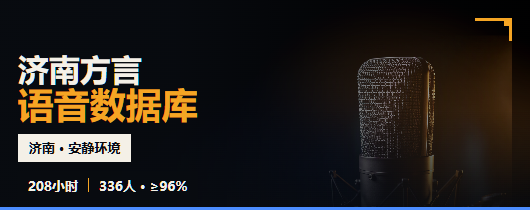
The Jinan Dialect Speech Database contains a total of 208 hours of recordings. The recorded language is the Jinan dialect, and the recording location is Jinan, China. A total of 336 speakers were invited to record using their mobile phones in quiet environments. This database has undergone professional proofreading, achieving a word accuracy rate of over 96%, making it suitable for research in areas such as voiceprint recognition and speech recognition.
2. Recording Corpus
Recording Text Results
The read-aloud portion of this database consists of conversational texts, including everyday chat topics such as greetings among friends and family, communication among colleagues, and customer service inquiries. Each speaker recorded a different number of texts, with the following distribution:
Number of Sentences · Number of Speakers · Percentage (100%)
0–500 · 82 · 24.40%
500–1K · 240 · 71.43%
1K–1.5K · 5 · 1.49%
1.5K–7.5K · 9 · 2.68%
Corpus Processing
De-identification: Removal of politically sensitive, personally private, pornographic, or violent content. Removal of special symbols such as <, >, [, ], ~, /, \, =, except for numeric strings. Elimination of content containing languages other than Chinese and English. Standardization of format.
3. Speaker Information
Gender Ratio
The database includes a total of 336 speakers—122 males and 214 females.
Gender · Male · Female · Total
Percentage · 36.3% · 63.7% · 100%
Age Distribution
The age distribution of the speakers is as follows: A (18–25 years old); B (26–40 years old); C (41–50 years old); D (51+ years old).
· Age Group · Number of Speakers · Percentage
A · 18–25 years old · 79 · 23.51%
B · 26–40 years old · 160 · 47.62%
C · 41–50 years old · 91 · 27.08%
D · 51+ years old · 6 · 1.79%
Total · · 100% · 336
4. Data Recording
Recording Environment
A quiet indoor setting, free from echoes and other voices.
Recording Equipment
Common smartphones such as Apple, Huawei, Xiaomi, OPPO, etc., were used. The data was stored in 16 kHz, 16-bit WAV files.
Recording Method
For the read-aloud segments, speakers recorded indoors using a smartphone app in close-mic mode, reading naturally without rote recitation.
Recording Duration Distribution
Speakers randomly selected texts and read them aloud; individual recording sessions lasted no more than 20 hours and no less than one minute. Approximately 62% of the recordings fell within the range of 1,500–2,000 seconds. Specific duration distribution is as follows:
Duration (seconds) · Number of Speakers · Percentage (100%)
0–1K · 7 · 2.08%
1K–1.5K · 18 · 5.36%
1.5K–2K · 210 · 62.50%
2K–3K · 72 · 21.43%
3K–5K · 19 · 5.65%
5K–25K · 10 · 2.98%
5. Speech Data Transcription
Transcribers convert audio into text, striving to ensure that the written content accurately reflects the spoken words. General guidelines are as follows: 1) The transcription must exactly match the spoken audio—no extra words, missing words, or errors. 2) Numbers should be transcribed in Chinese characters—for example, “one two three” instead of “123.” Pay attention to distinguishing between “one” and “yao,” and “two” and “liang.” 3) If the audio contains English pronunciation, it should be rendered in corresponding Chinese characters or left as English. Specific cases include: All letters or words in URLs should be capitalized—for example, “www” should be transcribed as “three W dot A B C dot com.” English words in the audio should be transcribed entirely in lowercase. English letters in the audio should be transcribed entirely in uppercase. For certain proper nouns written in all caps, maintain capitalization without spaces—for example, CEO, NBA, etc. 4) The completeness of annotations must align with actual pronunciation; no omissions allowed. 5) Except for traditional expressions (such as “one week,” “one year,” “the second day of the lunar month”), specialized terms (“ten years sharpening a sword”), and vague phrases (“a hundred or so,” “three or four”), all other data should be expressed in Arabic numerals.
6. Data File Directory
Directory Structure
The directory tree structure is as follows:
│Data Directory Structure
└─DOC (Text Description Files)
││├─content.txt (List of Transcribed Content)
││├─spk-info.txt (Speaker Information Table)
└─SPEECHDATA (Audio Folder)
││├─J001 (Speaker ID)
│││├─J001W000001.wav (Audio File)
命名规则
Directory Naming Rules
<CORPUS>/<USAGE>/<SpeakerID>/<wav_ID>e.g./SPEECHDATA/J001/J001W0000001.wav
Directory · Content · Notes
CORPUS · · Database Name
USAGE · SPEECHDATA · Folder Name
SpeakerID · J001 · Speaker ID
wav_ID · J001W0000001.wav · Audio File
File Naming Rules
<SpeakerID>_<wav_ID>e.g. J001W0000001.wav
File · Content · Notes
SpeakerID · J001 · Speaker ID
<SpeakerID>_<wav_ID> · W000001.wav · Audio ID
Data Sample Download
Samples
- Audio sample 1